
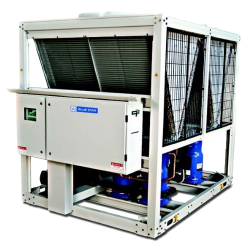
With an increased expectation and a heightened demand for better air conditioning and cooling solutions in this developing industrial age, the manufacturing businesses have been striving for improved operational efficiency, lower energy cost commitments, and reduced environmental impacts. At HI-Q Blue Star, we are a leading force in transforming the air cooling industry through innovative industrial air cooling systems that strike a balance between efficiency and sustainability.
Why Efficiency Matters in Industrial Cooling
Industrial activities, including data centers and heavy manufacturing, pharmaceutical laboratories and facilities, food processors, powerhouses, etc., create massive heat loads, and even common HVAC systems that rely on energy-deprived chillers and compressors (which often run non-stop for 24 hours) create high expenses and carbon footprints.
- Energy Costs: An entire building’s HVAC equipment can consume 40% of the total energy used in the building, which can lead to chronic energy costs. When energy systems happen to be inefficient, these energy costs can run you out of business.
- Environmental Costs: There’s nothing like increased regulatory pressure on an industry because of international accords that try to decrease greenhouse gas emissions.
- Process Reliability: An increased temperature can lead to a negative effect on the product quality and safety issues and decreased equipment life expectancy. Consistent temperature control is a requirement as well as a necessity.
All of which brings to the forefront the need for energy-efficient HVAC systems that have commercial-grade technology to provide the same cooling performance with much less energy used.
Leveraging Advanced HVAC Technologies
Let’s dive into the technological frontier shaping industrial process cooling future technologies. HI-Q Blue Star proactively incorporates into its air cooling solutions.
- Variable Frequency Drives (VFDs) & Smart Controls: The cooling systems can dynamically optimize the compressor and the fan speeds in response to the real-time load requirements through the usage of VFDs and control platforms. This helps in preventing the unnecessary full-speed operation of the coolers and also reduces the electricity consumption during partial loads.
- High-Efficiency Compressors & Eco-Friendly Refrigerants:The screw and scroll compressors of the modern era make sure that there is an optimal efficiency and use of the low GWP refrigerants such as R-32 and R-452B or the natural ones like CO₂ and ammonia. It ensures the elimination of the environmental footprint. The HI-Q Blue Star highlights the usage of these technologies to meet the global eco-standards.
- Waste Heat Recovery: Much energy is wasted in industrial settings as heat. With intelligent heat recovery systems, exhaust heat can be utilised for preheating processes, water systems, or heating facilities—optimising energy use and increasing combined heat and power (CHP) efficiency.
- Free Cooling with Evaporative or Air-Side Economizer Designs: When ambient temperatures permit, air-cooling systems can go into “free cooling” modes: using cool external air or evaporative methods to minimize compressor dependency. HI-Q Blue Star modular systems are optimized to take advantage of these natural cooling processes whenever the conditions are right.
- Liquid Cooling & Chilled Water Loops: Liquid-cooled systems and direct chilled-water systems offer point temperature control on high-accuracy applications (like a server farm or high-heat equipment). These systems have excellent thermal conductivity and can offer better energy reduction and extremely low air handling losses.
- Thermal Energy Storage (TES): TES systems (ice storage or chilled glycol tank) allow for off-peak cooling and will essentially shift energy use. With TES, the user reduces demand charges, helps to flatten load profiles, and can take advantage of lower electricity rates (off-peak).
- IoT & Predictive Maintenance Platforms: Efficiency occurs through intelligence. HI-Q Blue Star empowers its customers with IoT sensors that can be placed on compressors and condensers, ultimately allowing for real-time monitoring, predictive analytics, and potential service notifications, while running these systems continuously at peak efficiency and reducing downtime.
Strategic Benefits for Industrial Customers
When industrial customers adopt energy-efficient HVAC systems, the advantages spill into several areas:
- Operational cost savings: Reduced maintenance and lower energy expenses mean immediate ROI—usually within 2–4 years.
- Carbon responsibility: Energy efficiency is among the most effective methods to lower scope-1 and scope-2 emissions, assisting businesses in achieving sustainability targets.
- Process consistency: Accurate climate control maintains product quality, safeguards delicate equipment, and ensures safe operating conditions.
- Resilience & redundancy: scalable, modular systems that feature smart controls and redundant units improve uptime and system robustness.
- Compliance & incentives: Financial incentives are offered by many areas for energy-efficient improvements. Additionally, future regulations increasingly penalize high-emission infrastructure.
HI-Q Blue Star’s Vision for Industrial Cooling
At HI-Q Blue Star, we have a keen appreciation of the changing cooling requirements of today’s industry. Our industrial-strength air cooling solutions are designed with energy efficiency and flexibility in mind, including:
- Modular, scalable platforms that can be optimized for individual load profiles and scaled up over time.
- Intelligent integration with Building Management Systems (BMS) for seamless control of HVAC, lighting, and production machinery.
- Advanced diagnostic software that provides performance data, predictive maintenance, and remote service features.
- Eco-friendly refrigerant choices, striving toward low-GWP solutions without sacrificing reliability or performance.
- Adaptive free-cooling modes take advantage of ambient conditions to reduce compressor dependence and maximise operational efficiency.
- Tailored waste-heat recovery solutions, converting unwanted thermal output to usable energy for on-site utilisation.
Future Directions in Industrial Process Cooling
In the future, several innovations are on the verge of transforming the playing field:
AI-optimised optimisation: Self-regulating HVAC systems, powered by AI, will forecast future cooling requirements, learn production cycles, and even broker better energy tariffs in real time.
Hybrid thermal-electric system: Combining electrical compression with a form of thermal absorption technology, possibly even solar-thermal power (to eliminate dependence on grid power), which would be amazing.
Decarbonising refrigerants: The sector will increasingly move towards natural refrigerants, such as hydrocarbons or CO₂, built into system designs that comply with regulations and safety standards.
Mass-produced modularity: Mass-produced cooling “pods” for rapid deployment are coming to standardise design and installation for fast turnaround requirements for industrial or air conditioning installations.
Towards a cooler, greener industrial future
In conclusion, energy-efficient HVAC systems are not just a maintenance upgrade; they are an investment in sustainability, resilience, and sustainable competitive advantage through harnessing innovations from air cooling systems that can have free cooling and be fitted with smart controls and predictive maintenance to greatly improve efficiency, emissions savings, and the future-proofing of your business.
At HI-Q Blue Star, we are committed to leading this web evolution from industrial-grade cooling solutions that enable our clients to thrive in a low-carbon future. We will work with you, whether it is retrofitting an existing plant or designing a new facility, in delivering engineered performance that reduces the energy consumption, provides compliance with regulations and provides an unrivalled performance from designed HVAC systems that are ultimately matched to your operations.